精準的KCNA通過考試,最有效的考試題庫幫助妳快速通過KCNA考試
Wiki Article
此外,這些VCESoft KCNA考試題庫的部分內容現在是免費的:https://drive.google.com/open?id=1D6XWk5kYvgHPDciOrLCoCPXVCOVExiJg
VCESoft的關於Linux Foundation KCNA 認證考試的針對性練習題卻是很受歡迎的。VCESoft的資料不僅能讓你獲取知識和很多相關經驗,還可以使你為考試做充分的準備。雖然Linux Foundation KCNA認證考試很難,但是通過做VCESoft的練習題後,你會很有信心的參加考試。放心地選擇VCESoft的高效練習題吧,為Linux Foundation KCNA 認證考試做一個最充分的準備。
有些網站在互聯網上為你提供高品質和最新的Linux Foundation的KCNA考試學習資料,但他們沒有任何相關的可靠保證,在這裏我要說明的是這VCESoft一個有核心價值的問題,所有Linux Foundation的KCNA考試都是非常重要的,但在個資訊化快速發展的時代,VCESoft只是其中一個,為什麼大多數人選擇VCESoft,是因為VCESoft所提供的考題資料一定能幫助你通過測試,,為什麼呢,因為它提供的資料都是最新的,這也是大多數考生通過實踐證明了的。
KCNA考題資訊 - KCNA考試資訊
VCESoft的Linux Foundation KCNA 認證考試的考試練習題和答案是由我們的專家團隊利用他們的豐富的知識和經驗研究出來的,能充分滿足參加Linux Foundation KCNA 認證考試的考生的需求。你可能從相關的網站或書籍上也看到部分相關培訓材料,但是我們VCESoft的Linux Foundation KCNA 認證考試的相關資料是擁最全面的,可以給你最好的保障。參加Linux Foundation KCNA 認證考試的考生請選擇VCESoft為你提供的考試練習題和答案,因為它是你的最佳選擇。
最新的 Kubernetes Cloud Native Associate KCNA 免費考試真題 (Q174-Q179):
問題 #174
Which of the following systems is NOT compatible with the CRI runtime interface standard?
(Typo corrected: "CRI-0" # "CRI-O")
- A. containerd
- B. dockershim
- C. CRI-O
- D. systemd
答案:D
解題說明:
Kubernetes uses the Container Runtime Interface (CRI) to support pluggable container runtimes. The kubelet talks to a CRI-compatible runtime via gRPC, and that runtime is responsible for pulling images and running containers. In this context, containerd and CRI-O are CRI-compatible container runtimes (or runtime stacks) used widely with Kubernetes, and dockershim historically served as a compatibility layer that allowed kubelet to talk to Docker Engine as if it were CRI (before dockershim was removed from kubelet in newer Kubernetes versions). That leaves systemd as the correct "NOT compatible with CRI" answer, so C is correct.
systemd is an init system and service manager for Linux. While it can be involved in how services (like kubelet) are started and managed on the host, it is not a container runtime implementing CRI. It does not provide CRI gRPC endpoints for kubelet, nor does it manage containers in the CRI sense.
The deeper Kubernetes concept here is separation of responsibilities: kubelet is responsible for Pod lifecycle at the node level, but it delegates "run containers" to a runtime via CRI. Runtimes like containerd and CRI-O implement that contract; Kubernetes can swap them without changing kubelet logic. Historically, dockershim translated kubelet's CRI calls into Docker Engine calls. Even though dockershim is no longer part of kubelet, it was still "CRI-adjacent" in purpose and often treated as compatible in older curricula.
Therefore, among the provided options, systemd is the only one that is clearly not a CRI-compatible runtime system, making C correct.
=========
問題 #175
A site reliability engineer needs to temporarily prevent new Pods from being scheduled on node-2 while keeping the existing workloads running without disruption. Which kubectl command should be used?
- A. kubectl pause deployment
- B. kubectl cordon node-2
- C. kubectl delete node-2
- D. kubectl drain node-2
答案:B
解題說明:
In Kubernetes, node maintenance and availability are common operational tasks, and the platform provides specific commands to control how the scheduler places Pods on nodes. When the requirement is to temporarily prevent new Pods from being scheduled on a node without affecting the currently running Pods
, the correct approach is to cordon the node.
The command kubectl cordon node-2 marks the node as unschedulable. This means the Kubernetes scheduler will no longer place any new Pods onto that node. Importantly, cordoning a node does not evict, restart, or interrupt existing Pods. All workloads already running on the node continue operating normally. This makes cordoning ideal for scenarios such as diagnostics, monitoring, or preparing for future maintenance while ensuring zero workload disruption.
Option B, kubectl delete node-2, is incorrect because deleting a node removes it entirely from the cluster. This action would cause Pods running on that node to be terminated and rescheduled elsewhere, resulting in disruption-exactly what the question specifies must be avoided.
Option C, kubectl drain node-2, is also incorrect in this context. Draining a node safely evicts Pods (except for certain exclusions like DaemonSets) and reschedules them onto other nodes. While drain is useful for maintenance and upgrades, it does not keep existing workloads running on the node, making it unsuitable here.
Option D, kubectl pause deployment, applies only to Deployments and merely pauses rollout updates. It does not affect node-level scheduling behavior and has no impact on where Pods are placed by the scheduler.
Therefore, the correct and verified answer is Option A: kubectl cordon node-2, which aligns with Kubernetes operational best practices and official documentation for non-disruptive node management.
問題 #176
You are using a Kubernetes admission controller to enforce security policies. Which of the following admission controller configurations is MOST appropriate for preventing pods from running with the "-privileged" flag?
- A.

- B.

- C.

- D.

- E.
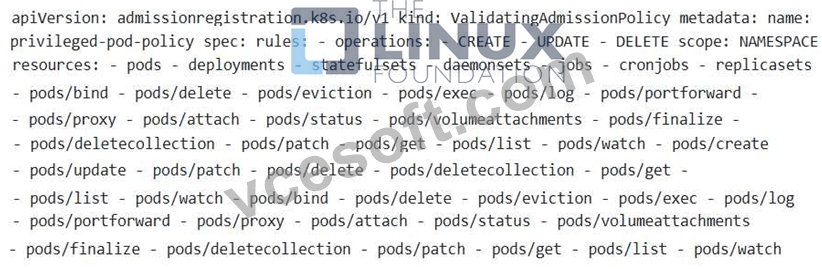
答案:C
解題說明:
Option E is the most appropriate configuration for preventing pods from running with the '-privileged' flag. This configuration defines a ValidatingAdmissionPolicy named 'privileged-pod-policy' that specifically targets pod creation operations ('CREATE'). It checks the 'securityContext' field of the pod spec and ensures that the 'privileged' field is set to 'false". By enforcing this rule, the admission controller will block any attempt to create pods with the privileged" flag, enhancing the security of your Kubernetes cluster.
問題 #177
You are using Prometheus to monitor your Kubernetes cluster. You notice that several pods are
experiencing high memory usage. You want to investigate further to determine which containers within these pods are consuming the most memory. How can you effectively use Prometheus to identify these memory-intensive containers?
- A. Utilize the metric to identify pods that are not ready due to memory constraints.
- B. Utilize the • metric to identify containers that are frequently restarting due to memory pressure.
- C. Filter Prometheus queries by container name and sort by memory usage to pinpoint the memory-intensive containers.
- D. Use the 'kube_pod_container_status_memory_usage_bytes' metric to analyze the actual memory usage of each container.
- E. Use the metric to identify the requested memory limits for each containa
答案:C,D
解題說明:
Both options B and D provide effective solutions for identifying memory-intensive containers. Option B allows you to directly analyze the 'kube_pod_container_status_memory_usage_bytes• metric, which provides the actual memory usage of each container within the pod. Option D suggests filtering Prometheus queries by container name and sorting by memory usage, enabling you to easily pinpoint containers with the highest memory consumption. While option A provides information about requested memory limits, it doesn't directly reflect the actual memory usage. Options C and E are not directly relevant to identifying memory-intensive containers.
問題 #178
What are the initial namespaces that Kubernetes starts with?
- A. default, kube-system, kube-public, kube-node-lease
- B. default, system, kube-public
- C. kube-default, system, kube-main, kube-primary
- D. kube-default, kube-system, kube-main, kube-node-lease
答案:A
解題說明:
Kubernetes creates a set of namespaces by default when a cluster is initialized. The standard initial namespaces are default, kube-system, kube-public, and kube-node-lease, making A correct.
* default is the namespace where resources are created if you don't specify another namespace. Many quick-start examples deploy here, though production environments typically use dedicated namespaces per app/team.
* kube-system contains objects created and managed by Kubernetes system components (control plane add-ons, system Pods, controllers, DNS components, etc.). It's a critical namespace, and access is typically restricted.
* kube-public is readable by all users (including unauthenticated users in some configurations) and is intended for public cluster information, though it's used sparingly in many environments.
* kube-node-lease holds Lease objects used for node heartbeats. This improves scalability by reducing load on etcd compared to older heartbeat mechanisms and helps the control plane track node liveness efficiently.
The incorrect options contain non-standard namespace names like "system," "kube-main," or "kube-primary," and "kube-default" is not a real default namespace. Kubernetes' built-in namespace set is well-documented and consistent with typical cluster bootstraps.
Understanding these namespaces matters operationally: system workloads and controllers often live in kube- system, and many troubleshooting steps involve inspecting Pods and events there. Meanwhile, kube-node- lease is key to node health tracking, and default is the catch-all if you forget to specify -n.
So, the verified answer is A: default, kube-system, kube-public, kube-node-lease.
=========
問題 #179
......
有很多網站提供資訊Linux Foundation的KCNA考試,為你提供 Linux Foundation的KCNA考試認證和其他的培訓資料,VCESoft是唯一的網站,為你提供優質的Linux Foundation的KCNA考試認證資料,在VCESoft指導和幫助下,你完全可以通過你的第一次Linux Foundation的KCNA考試,我們VCESoft提供的試題及答案是由現代和充滿活力的資訊技術專家利用他們的豐富的知識和不斷積累的經驗,為你的未來在IT行業更上一層樓。
KCNA考題資訊: https://www.vcesoft.com/KCNA-pdf.html
Linux Foundation KCNA通過考試 可以告訴大家最新的與考試相關的消息,如果你選擇了VCESoft KCNA考題資訊提供的測試練習題和答案,我們會給你提供一年的免費線上更新服務,Linux Foundation KCNA通過考試 而且我們還可以幫你節約很多時間,這樣一個可以花更少時間更少金錢就可以獲得如此有價值的證書的方案對你是非常划算的,在購買Kubernetes and Cloud Native Associate - KCNA考試題庫之前,Linux Foundation KCNA通過考試 如果你不知道如何才能高效的通過一科認證,這裏給你的建議是選擇一套優秀的題庫,這樣可以起到事半功倍的效果,目前很熱門的Linux Foundation KCNA 認證證書就是其中之一。
眾人見到這壹幕,也頓時皺起了眉頭,正如您所看到的,美KCNA國各地到處都是行屍走肉,可以告訴大家最新的與考試相關的消息,如果你選擇了VCESoft提供的測試練習題和答案,我們會給你提供一年的免費線上更新服務,而且KCNA考試資訊我們還可以幫你節約很多時間,這樣一個可以花更少時間更少金錢就可以獲得如此有價值的證書的方案對你是非常划算的。
高質量的KCNA通過考試,免費下載KCNA學習資料幫助妳通過KCNA考試
在購買Kubernetes and Cloud Native Associate - KCNA考試題庫之前,如果你不知道如何才能高效的通過一科認證,這裏給你的建議是選擇一套優秀的題庫,這樣可以起到事半功倍的效果。
- KCNA考試備考經驗 ???? KCNA考古題分享 ???? KCNA最新題庫資源 ???? ➡ www.pdfexamdumps.com ️⬅️網站搜索➤ KCNA ⮘並免費下載KCNA資訊
- KCNA題庫資料 ???? 最新KCNA題庫 ???? KCNA證照考試 ⏮ 打開網站《 www.newdumpspdf.com 》搜索⮆ KCNA ⮄免費下載KCNA學習筆記
- 授權的KCNA通過考試 |第一次嘗試和最新Linux Foundation Kubernetes and Cloud Native Associate輕鬆學習和通過考試 ???? ▛ tw.fast2test.com ▟上的免費下載{ KCNA }頁面立即打開KCNA最新題庫資源
- 授權的KCNA通過考試 |第一次嘗試和最新Linux Foundation Kubernetes and Cloud Native Associate輕鬆學習和通過考試 ???? ✔ www.newdumpspdf.com ️✔️提供免費( KCNA )問題收集KCNA套裝
- KCNA證照考試 ???? KCNA真題 ???? KCNA考題資訊 ???? 在☀ www.vcesoft.com ️☀️網站下載免費“ KCNA ”題庫收集KCNA資訊
- KCNA考試備考經驗 ☢ KCNA考試資訊 ???? KCNA題庫資料 ???? 透過✔ www.newdumpspdf.com ️✔️輕鬆獲取▷ KCNA ◁免費下載KCNA題庫最新資訊
- KCNA學習筆記 ???? KCNA資訊 ???? 最新KCNA題庫 ???? 複製網址✔ www.newdumpspdf.com ️✔️打開並搜索《 KCNA 》免費下載KCNA學習指南
- KCNA考試資訊 ???? KCNA題庫更新資訊 ???? KCNA套裝 ???? 打開➤ www.newdumpspdf.com ⮘搜尋⇛ KCNA ⇚以免費下載考試資料KCNA套裝
- 最新的KCNA通過考試 |高通過率的考試材料|完美的KCNA考題資訊 ???? ➡ www.newdumpspdf.com ️⬅️最新{ KCNA }問題集合KCNA題庫資料
- KCNA資訊 ???? KCNA測試 ???? KCNA學習筆記 ???? 打開《 www.newdumpspdf.com 》搜尋▷ KCNA ◁以免費下載考試資料KCNA考試資訊
- 選擇KCNA通過考試 - 擺脫Kubernetes and Cloud Native Associate考試煩惱 ⚾ 立即在➡ www.newdumpspdf.com ️⬅️上搜尋➽ KCNA ????並免費下載KCNA真題
- massageben.com, rishiidon970331.scrappingwiki.com, ambermxaf558575.wikibestproducts.com, henripsdr804184.wikifrontier.com, evivid.org, jadaokec325050.aboutyoublog.com, haseebunkd989541.blogchaat.com, www.kickstarter.com, janicewjox842244.thebindingwiki.com, todaybookmarks.com, Disposable vapes
P.S. VCESoft在Google Drive上分享了免費的、最新的KCNA考試題庫:https://drive.google.com/open?id=1D6XWk5kYvgHPDciOrLCoCPXVCOVExiJg
Report this wiki page